Spring 2026
Social Media Fingerprinting: expanding UGC monetization beyond YouTube to TikTok, Instagram, and Facebook so independent artists can earn from every eligible use of their music. I served as Design Lead on a cross-functional pod (PM, Tech Lead, Data Science, TPM, iOS), shipped as an iOS experiment in Spring 2026.
iOS Experiment
Growth Experiment
Project Details
Role
Design Lead, Growth & Monetization
Team
1 Design Lead, 1 Product Manager, 1 Tech Lead, 1 Data Scientist, 1 Technical Project Manager, 2 iOS Engineers
Tools Used
Claude, Figma, Jira, Amplitude
Experience Gained
Leading design on a cross-functional team on two-week sprint cycles, working directly with data science to design the A/B test and instrument the funnel end to end. Learned to build pricing and packaging that widens an offer without forcing existing customers to migrate, and to read a guardrail metric honestly when it contradicts the headline result.
Overview

The Problem
One platform, one price, and almost nobody buying.
Only 5.76% of eligible artists purchased. A third tapped in to learn more; fewer than one in five of those converted. The offer was the problem, not the interest.
It covered a single platform. And the copy never explained the thing that made it worth buying: UGC royalties are separate from streaming royalties. Money you're already owed and not collecting.

Hypothesis
If the offer covered every platform artists earn on, more of them would buy.
Adding TikTok and Meta fingerprinting would strengthen the value proposition enough to convert artists who understood the product but didn't think it was worth the money.
Primary: purchase conversion, UGC Fingerprinting revenue
Guardrail: release submissions, since the upsell sits inside the release journey
Every experiment had to ship in one two-week sprint. That's why this is a targeted intervention on the highest-leverage screens, not a redesign.

The Solution
Adding three platforms without taking one away.
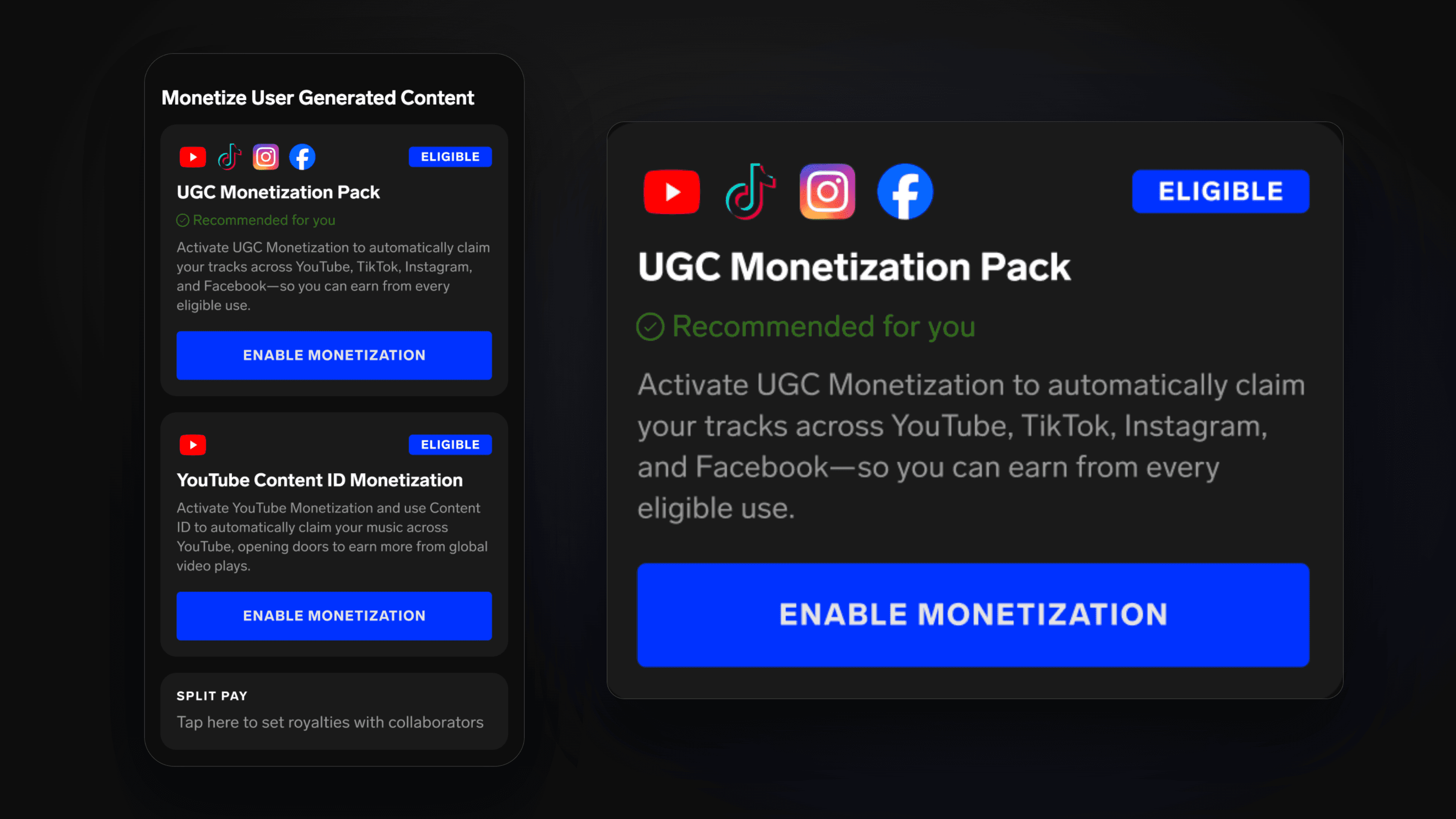
Made the scope legible. Four platform marks replaced the lone YouTube logo.
Rewrote the value prop around the royalty gap. "Earn from every eligible play," separating UGC from streaming royalties.
Bundled, didn't replace. The $7.99 Pack adds YouTube Content ID; YouTube-only stayed purchasable.
Priced the upgrade path. $2.99 round-up for existing YouTube Content ID owners.
Added a "Recommended for you" signal on the release-details upsell.
Closed the post-purchase loop with platform status states.
Experiment Design
A clean 50/50 on the surface where the money moves.
iOS drove the most Content ID purchases, so we split it there: control saw YouTube-only, treatment saw the Pack as the lead option.
I tracked the full funnel, impressions to abandonment to purchase, with release submissions as a guardrail. That's what caught the negative result below. Measured at the endpoint alone, this would have read as a straightforward win.

Results
+62.5% purchase rate. +79.1% Content ID revenue.
Purchase rate rose from 5.76% to 9.35%, and 55% more artists entered the flow. All primary results were statistically significant and leading.
Revenue outgrew purchase rate by 17 points, which means conversion improved even as the price went up. The Pack cost more than the offering it replaced, so the expected tradeoff was fewer buyers at a higher take. We got more buyers instead.

Reflection
Diagnose the funnel before you touch the screen.
A 5.76% conversion rate looks like a design problem. The funnel said otherwise: artists were tapping in, then leaving.
That's a value problem, not an attention problem, which put the leverage in the offer and the copy rather than the layout. I'd rather find the exact point a flow loses people than assume the screen is at fault.
Second, widening an offer beats forcing a migration. Keeping YouTube-only purchasable cost nothing and protected the artists who already knew the product.
Third, every lift has a price. The upsell raised purchases and pulled attention from the release flow, dropping submissions 18.6%. Both were true at once, and the guardrail is the only reason I caught it.